











If children or teenagers keep cutting through your yard, opening a gate, or gathering near your home, you might be wondering how to address the situation. The best response depends on whether you are seeing danger, damage, repeated disregard, or a harmless shortcut.
Start with safety, then clarify either permission or a boundary. Despite what some parts of the internet might have you believe, you don't actually have to treat every child who steps onto a lawn like a serious threat.
The Short Answer
Intervene safely when a child is in immediate danger. For lower-risk situations, confirm what is happening, make the boundary clear, and contact a parent or guardian when appropriate. Document repeated entry or damage, but keep the response proportionate to the behavior.
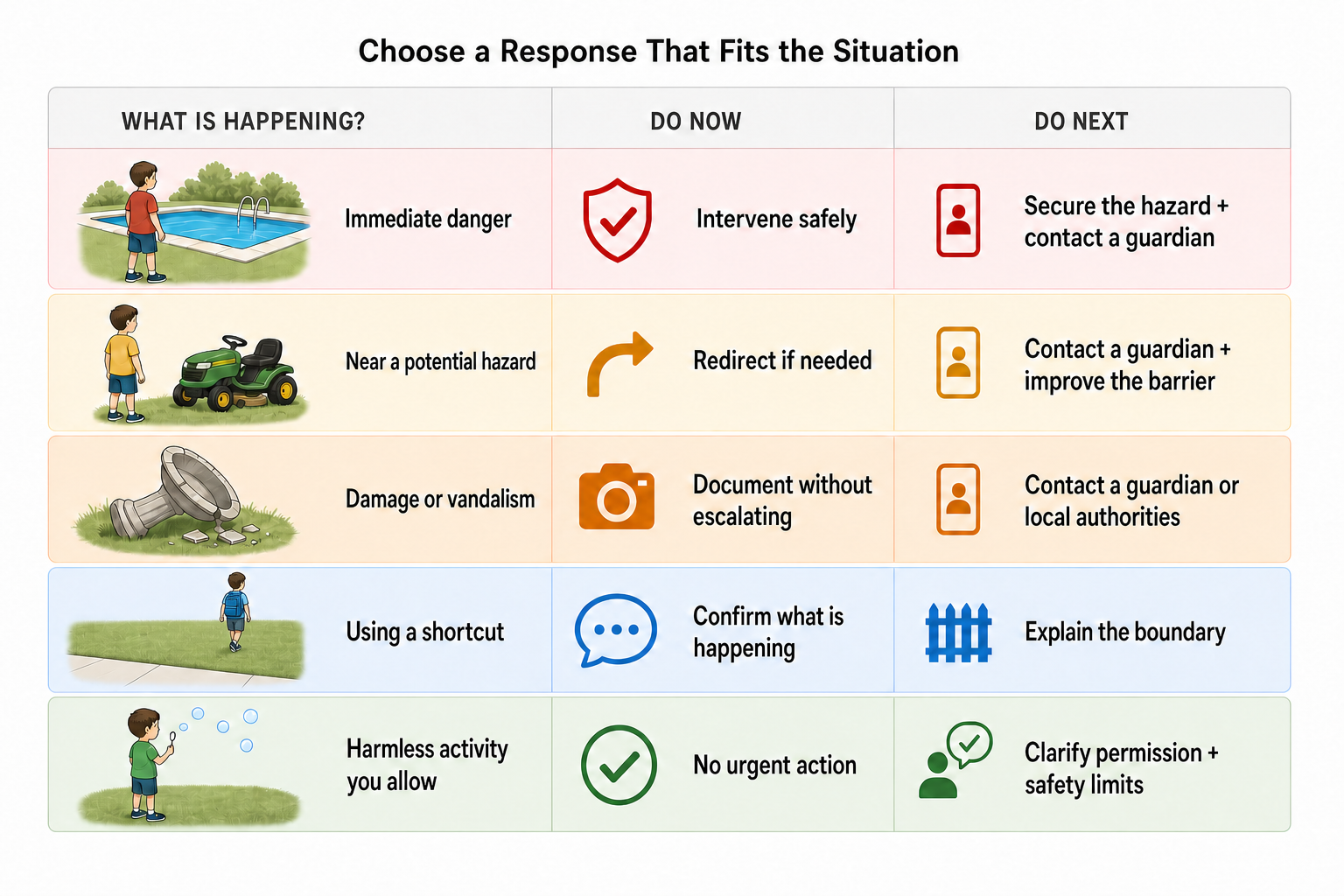
Secure Serious Hazards First
Pools, machinery, chemicals, unstable structures, animals, vehicles, and construction areas can turn an annoying boundary problem into an emergency. If a child is in immediate danger, intervene as safely as possible and call for emergency help if needed.
Nuisance and premises-liability rules can create added responsibilities for dangerous conditions that children may not understand. The details vary by state, but don't assume you have zero liability for what happens to a trespasser, especially children.
Use physical protection where it counts. The U.S. Consumer Product Safety Commission recommends layers such as pool barriers, self-closing and self-latching gates, covers, and alarms. A camera may alert you to entry, but it cannot replace a barrier.
Read Cornell Law School's overview of attractive nuisance
Review CPSC guidance on child safety barriers
Confirm What Is Actually Happening
A worn line across one corner of the lawn suggests a shortcut. An opened gate, children climbing on equipment, or repeated damage suggests something else. Before confronting anyone, separate what you know from what you suspect.
For repeated incidents, note the date, time, entry point, behavior, and any damage. An appropriately used security camera can help clarify what is actually happening. Before escalating, it's also smart to confirm the boundary if shared driveways, easements, or common areas make ownership unclear.
Do You Have to Stop Harmless Use You Do Not Mind?
Not necessarily. Permission to enter or use land can be express or implied, and you may choose to allow a harmless shortcut or other limited use. However, permission can affect how the visitor is treated under property law, and a landowner's duties vary by jurisdiction.
Set limits that everyone can understand. For example, children may cross one open corner during daylight but may not enter a fenced yard or touch equipment. Tell a parent or guardian when practical, secure serious hazards, and check local advice or your insurer when a pool, trampoline, machinery, or another higher-risk feature is involved.
Of course, you may also withdraw permission anytime. Just be sure to communicate the change clearly to avoid ambiguity.
Read Cornell Law School's definition of permission to use land
Learn why duties to permitted visitors vary by jurisdiction
Make the Boundary Clear, Then Talk to a Parent
Lawn shortcuts might be redirected with a planter or small fence. Repair loose gate latches, close fence gaps, or add a sign such as "Private Property" or "Please Use the Sidewalk." Sign requirements vary, so treat signage as clarification rather than a complete solution.
If you are familiar with the family and it feels safe, have a non-accusatory conversation with the parent or guardian, something like: "I have seen the kids crossing our side yard several times this week. We need them to use the sidewalk instead because there is equipment nearby. Could you please speak with them?"
That states what happened, identifies the concern, and asks for one change. If the conversation becomes argumentative, end it politely and keep later communication brief and in writing.
Document the Pattern Without Publicly Shaming Anyone
A short written log may be enough. A security camera can add timestamps, confirm the route, and preserve evidence of damage. Aim it at your own gate, yard, driveway, or fence line, and adjust motion zones to reduce unnecessary recording of the public sidewalk or neighboring property.
Save relevant clips, but check local rules before relying on recorded audio. Do not post identifiable footage of minors simply to embarrass them or pressure their parents. Share evidence privately with a parent, property manager, insurer, or authority when there is a legitimate reason.
A visible outdoor camera can support documentation and alerts, but it is only one layer. Clear communication and a safer physical boundary usually do more to resolve the underlying problem.
Plan camera coverage around the areas you actually need to monitor
Read about camera placement and neighbor privacy
Learn why publicly posting security footage deserves extra care
Browse aosu outdoor security camera systems
Escalate Only as Far as the Situation Requires
If a clear request and physical boundary do not work, escalate only as much as needed: a landlord, property manager, HOA, school, team, or other relevant organization.
For repeated entry, past damage, or another non-urgent concern, contact your local police or sheriff's non-emergency number and ask what documentation or notice is appropriate. Call 911 only when immediate police, fire, or medical assistance is needed, such as an injury, serious active damage, or a child in immediate danger.
Review the National 911 Program's guidance on emergency calls
What Not to Do
- Do not create traps
Never use hidden wire, dangerous obstacles, paint, or anything intended to injure, confine, or mark someone.
- Do not grab or chase a child
Outside an immediate safety emergency, keep your distance and use calm words directly with the trespasser, contact their guardian, or alert an authority as befits the situation.
- Do not threaten or publicly shame
State the boundary and preserve evidence privately. Avoid threats about arrest, lawsuits, school punishment, or online exposure.
- Do not assume bad intent
A child may not understand the boundary or may be following an established shortcut. Politely address the problem before escalating.
To Wrap Up
Secure serious hazards first, then decide whether the behavior needs to stop, needs clearer limits, or is harmless enough to allow. A proportionate response protects your property without creating a larger than necessary conflict.
You can value privacy and still be a friendly neighbor. Clear permission, clear boundaries, and factual documentation leave room for both.
FAQs
Do I need to tell kids to stay off my property if I do not mind them there?
Not necessarily. You may choose to allow harmless use of part of your property, but make the permitted area and activities clear, secure serious hazards, and let a parent or guardian know when practical. Permission and premises-liability rules vary by state, so check local advice for a specific concern or higher-risk feature.
Should I call the police if kids keep trespassing on my property?
For repeated but non-urgent trespassing, use the local police or sheriff's non-emergency number and ask what documentation or notice is appropriate. Call 911 only when someone is injured, in immediate danger, causing serious active damage, or creating another situation that requires immediate assistance.
Could I be liable if a trespassing child gets hurt?
Possibly, depending on the location, circumstances, and state law. Dangerous conditions that are likely to attract children can create added responsibilities under premises-liability or attractive-nuisance rules. Secure serious hazards and ask a qualified local professional about a specific legal concern.
Can I record kids trespassing in my yard?
A camera focused on your own yard, gate, or entry route may help document what happened, but privacy and audio-recording laws vary. Keep the view centered on your property, protect the footage, and avoid publicly posting identifiable videos of minors.
Will a No Trespassing sign solve the problem?
A sign can clarify that the area is private and may support formal notice in some jurisdictions, but it will not physically stop entry. It's best to pair it with a repaired gate, fence, landscaping barrier, or other change that closes the route.