






































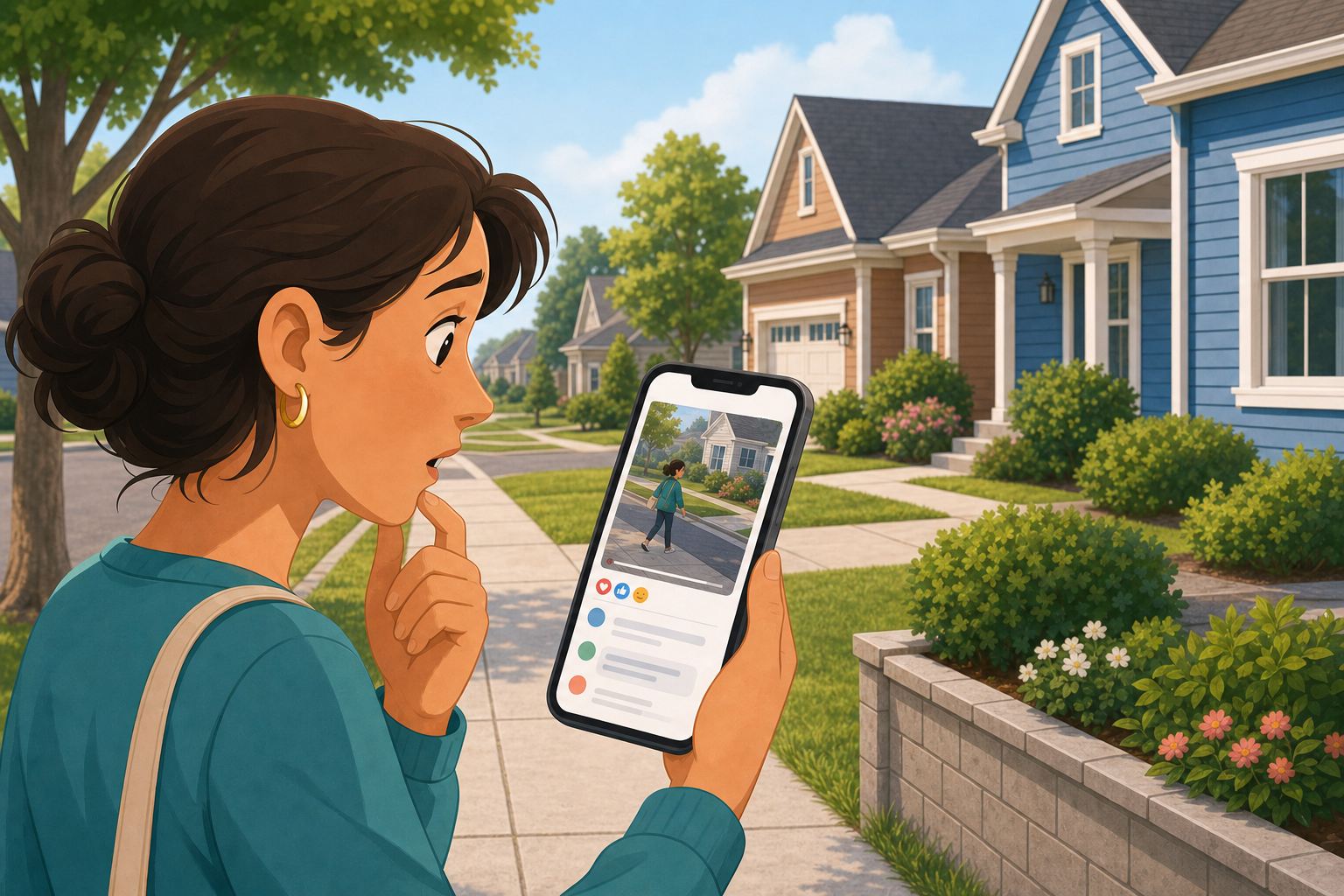
Finding a video of yourself in a neighborhood Facebook group or on Nextdoor can feel invasive, especially when strangers are commenting on where you were going or what they think you were doing.
In the United States, it is often lawful to post a recorded video of someone on a public sidewalk. However, the recording, accompanying caption, audio, personal information, and way the video is used can create separate privacy, defamation, harassment, or platform-policy issues.
This guide explains the practical questions to ask and the steps you can take. It provides general U.S. information, not legal advice. Recording, privacy, defamation, harassment, and right-of-publicity laws vary by state and by the facts of each situation.
The Short Answer
If you were walking on a public sidewalk and appeared in a doorbell or security-camera video, the person who recorded it may be allowed to share it without first getting your permission. There is no general rule that every identifiable person in public must consent before a video can be posted.
That is only the starting point. A lawful public-place recording can still become a problem if the post adds a false factual accusation, exposes private information, includes unlawfully recorded audio, encourages harassment, threatens you, or uses your likeness commercially.
Platform rules are another separate layer. Facebook, Nextdoor, and other services can restrict bullying, harassment, threats, doxxing, or public shaming even when a post does not clearly violate a law.
Recording the Video and Posting it Are Different Questions
First ask whether the footage itself was recorded lawfully. Then look at the entire context of the post itself.
For example, a doorbell camera may lawfully capture people passing a home. But a post that falsely identifies one of those people as a thief raises a different issue. In the same way, a silent street video and a clip containing a clearly audible private conversation may require different analysis.
| Questions about the recording | Questions about the post |
|---|---|
|
|
Read: Can My Neighbor Record Me on My Property?
When a Sidewalk Video May Cross a Line
Commercial use can also require a closer look. Using a person's identity in an advertisement or endorsement is different from sharing neighborhood footage for discussion or newsworthy information. State right-of-publicity rules vary.
If a child appears in the footage, a parent or guardian should use any platform privacy or child-safety reporting process that applies. The presence of a minor does not automatically make every public-place video unlawful, but it can affect safety concerns and platform review.
Here's what may cross a line:
| A false factual accusation | Private or identifying information | Harassment, threats, or repeated targeting | Private audio or private activity |
|---|---|---|---|
|
|
|
|
General legal reference: Defamation
General legal reference: Intrusion on Seclusion
Audio is Treated Seperately
Video-recording rules and conversation-recording rules are not always the same. Federal law sets a one-party-consent baseline for certain recordings, but state laws can be more restrictive, and several states have all-party or mixed consent requirements.
The key issue is often whether the people speaking had a reasonable expectation that the conversation was private. Ordinary street noise or a voice projected in public may be different from a focused recording of a quiet conversation that was not meant to be overheard.
If the posted clip includes a conversation, preserve the original post and check the law in the state where the recording occurred. Do not assume that a camera's microphone was lawful simply because its video view was.
Review the Reporters Committee state recording-law guide
Read: Do Security Cameras Have Sound?
A Platform May Remove a Legal Post
A platform does not need to wait for a court to decide that a post is unlawful. Social networks and neighborhood apps have their own rules for bullying, harassment, threats, impersonation, exposed personal information, and other harmful behavior.
That also means a report should focus on the rule the post actually appears to violate. A simple statement that you did not consent to being filmed may not be enough when the video shows an ordinary public sidewalk. A report explaining the false accusation, exposed address, threat, child-safety concern, or repeated targeting gives the reviewer a more specific issue to evaluate.
Reporting menus and appeal options change over time. Use the current help center for the platform, select the most accurate category, and keep a copy of what you submitted.
Meta: How Facebook addresses bullying and harassment
Nextdoor policy and transparency center
What to Do if a Neighbor Posts a Video of You
Avoid retaliating in the comments or making unverified legal threats. A short, factual record is generally more useful to moderators, platform reviewers, attorneys, or authorities than a public argument.
If there is an immediate danger or a credible threat of violence, contact emergency services rather than waiting for a platform review.
- Save the post and its context
Capture the video or screenshots, full caption, comments, username, group name, date, time, and direct URL. Record any edits or reposts.
- Identify the exact concern
Write down whether the problem is a false claim, exposed information, private audio, a threat, harassment, a child-safety issue, or simply an unwanted image.
- Ask the poster for a specific change
If it feels safe, calmly request deletion or a narrower remedy such as correcting the caption, blurring your face, removing audio, or cropping identifying details.
- Contact the group administrator
For a neighborhood group, send the administrator the direct link, a short explanation, and the exact rule or harm involved. Ask them to remove the post or limit further discussion.
- Apply to the platform for removal
Use the post's reporting tool or the platform's privacy, bullying, harassment, threats, exposed-information, or child-safety process. Choose the most accurate reason and include specific evidence.
- Appeal, document, or seek help when needed
If an appeal is available, explain what the first review missed. Keep documenting reposts or targeting. Seek local legal advice or contact the appropriate authority for serious defamation, stalking, doxxing, or credible threats.
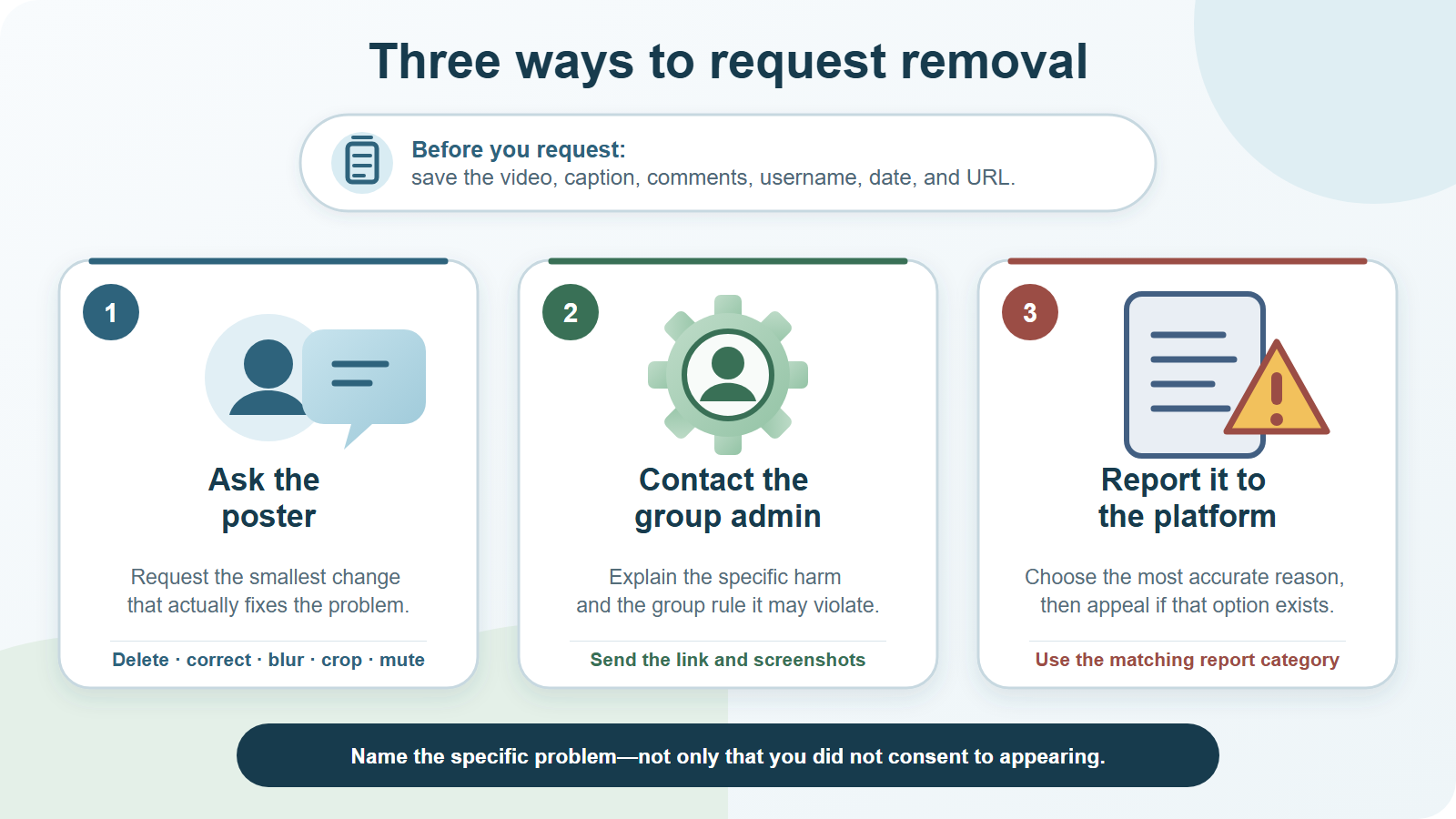
Three practical removal routes: ask the poster, contact the group administrator, and submit a platform report.
How to Make a Stronger Removal Request
A removal request works best when it tells the recipient exactly what happened and exactly what would resolve it. Keep the tone calm and avoid overstating what the law requires.
A simple message can say something like:
“I am the person shown in this post. The caption incorrectly states that I was taking packages. I was walking past the property and did not enter it. Please remove the post or correct the caption and remove my identifying information. I have attached the URL and screenshots.”
For a privacy or safety report, replace the middle sentences with the specific issue: the post shows your address, includes a private conversation, identifies your child, contains a threat, or is part of repeated targeting.
| Include | Avoid |
|---|---|
|
|
Before Posting Security-Camera Footage of Someone Else
Security footage can help neighbors identify a real safety issue, but public posting is not always the best first step. If the clip may be evidence of a crime or an immediate safety concern, sharing it privately with law enforcement, a property manager, or the directly affected person may be more useful.
If you do post, describe only what the footage actually shows. Avoid turning a question into an accusation. “Does anyone recognize this person who approached my porch at 2:10 a.m.?” is different from declaring that the person is a thief when the video does not show a theft.
Crop or blur uninvolved people when practical, remove unnecessary audio, and avoid exposing addresses, license plates, access codes, documents, or other information that is not needed to explain the event. If the concern is resolved, update or remove the post so an outdated accusation does not keep circulating.
Can cameras face public sidewalks?
To Wrap Up
A neighbor can often share footage of activity that was lawfully visible on a public sidewalk, even without the subject's permission. But the video is only part of the post. Audio, captions, identifying information, threats, repeated targeting, commercial use, and platform policies can change the situation.
Start by preserving the post and identifying the specific harm. Then ask for the narrowest useful correction, contact the group administrator, and submit a well-supported platform removal request. When the post involves serious false accusations, stalking, doxxing, or credible threats, get qualified local help rather than relying only on a social-media report.
FAQs
Can someone post a video of me without my permission?
Often, yes, if the video was lawfully recorded in a place where you did not have a reasonable expectation of privacy. The answer can change when the post includes private audio, false factual claims, personal information, harassment, threats, commercial use, or other legally significant details.
Can I make Facebook or Nextdoor remove a video of me?
You can request removal, but appearing in a public-place video may not be enough by itself. Report the specific issue—such as bullying, harassment, a threat, exposed personal information, a false accusation, or a child-safety concern—and appeal if the platform offers that option.
Can I make someone remove a false claim about me from social media?
A false factual statement that harms a person's reputation may raise defamation concerns. State law, the exact wording, evidence, fault, and harm all matter, so seek qualified local advice for a serious accusation. In a lower stakes situation, you can submit an appeal to the social media platform.
Is it legal for a security camera to record conversations on the sidewalk?
Audio rules vary by state and by whether the speakers reasonably expected the conversation to be private. Publicly audible street speech may be treated differently from a focused recording of a private conversation. Check the law where the recording occurred.
What if my neighbor posts a sidewalk video showing my child?
A parent or guardian can ask the poster and group administrator to remove or blur the child and can use the platform’s privacy or child-safety reporting process. Explain any identifying details or safety risk. Laws vary by location, and the fact that a child appears in a public-place video does not automatically make the recording or post illegal.