





















A lot of people have the same reaction when a blurry security camera clip goes viral: why does this look so bad when my old phone records clearer video?
It is a fair question. Phone video often does look better. But a phone and a security camera are made for completely different things.
A person with a phone is close to the action, aiming at the subject, choosing the angle, and recording a short moment. A security camera is fixed in place, watching a wide area all day, often from far away, while trying to save storage, battery, bandwidth, and processing power.
That difference comes to play whether the clip is an alleged UFO, a strange light in the sky, a porch theft, a car break-in, or a news clip asking the public to identify a suspect.
The Short Answer
Security camera footage often looks bad because the camera is built to detect activity from a fixed position, not produce phone-quality video of whatever later becomes important.
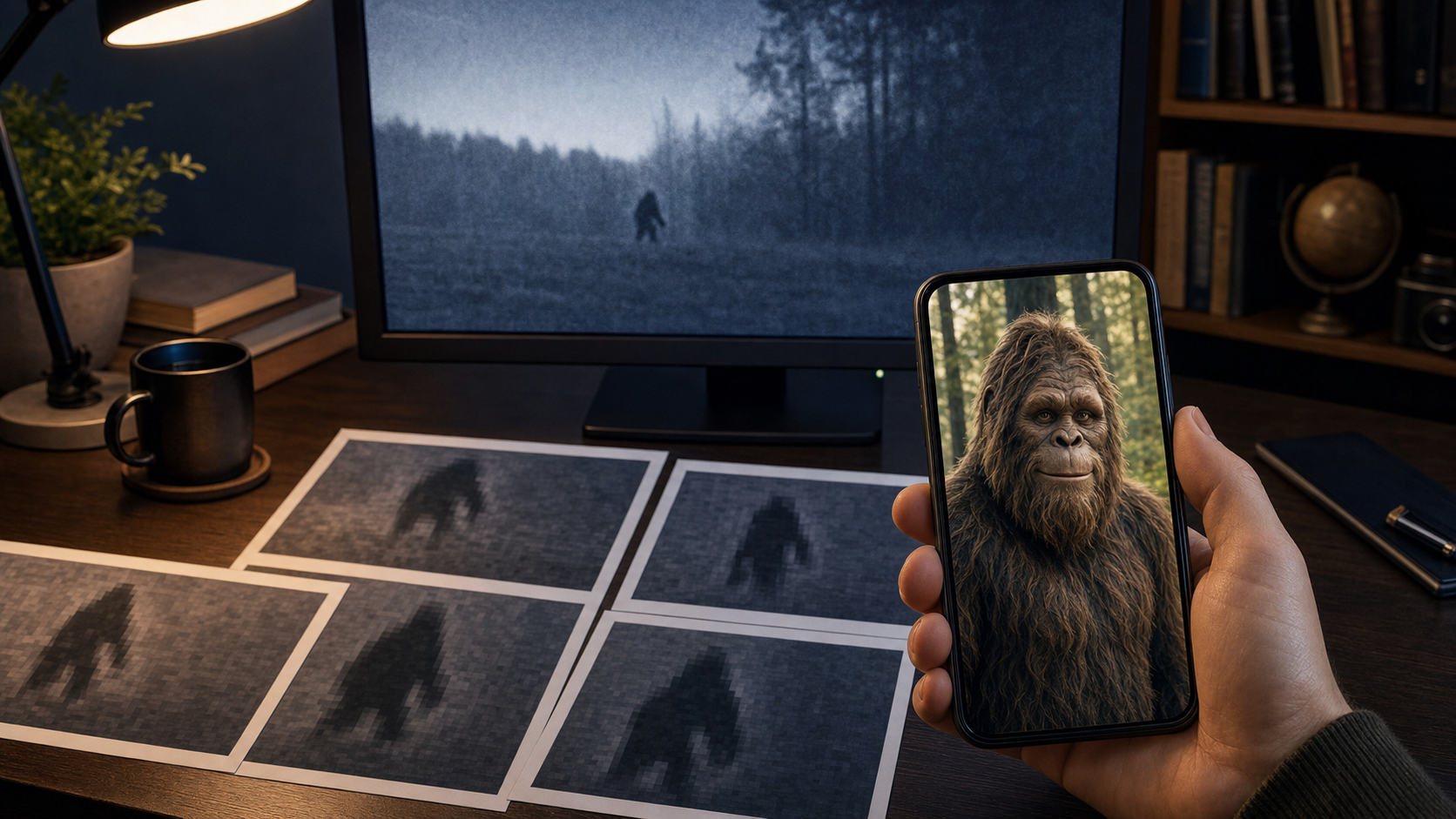
There are really two versions of the problem. Strange-object clips often look bad because the object is tiny, close to the lens, far away, bright, reflective, fast, or filtered by motion detection. Suspect clips often look bad because the camera captured the event but not enough identifying detail.
The clip may be real and still be weak evidence. It can show that something happened without proving exactly what the object was, who the person was, or how far away the subject actually was.
| Strange-object clips | Suspect or news clips |
|---|---|
|
|
Why Phone Footage Often Looks Better
Your phone is a high-end camera system that happens to fit in your pocket. It has expensive sensors, lenses, image processing, autofocus, stabilization, HDR, and a person operating it.
That last part is huge. When someone records with a phone, they usually point at the subject, move closer, reframe, tap to focus, adjust their position, and record only the interesting moment. The phone is not trying to watch the entire driveway for twelve hours.
A security camera is different. It is fixed to a wall, eave, post, or doorframe. It may be watching a whole yard, street, porch, or parking lot. It cannot walk closer, lean around a tree, choose a better angle, or decide that one specific object is suddenly important.
There is also a cost problem. Putting phone-level camera hardware and phone-level processing into every camera around a home would get expensive fast, especially if a system has four, eight, or twelve cameras. Then you still have to store or upload all that video continuously.
| Why phones often win | Why security cameras struggle |
|---|---|
|
|
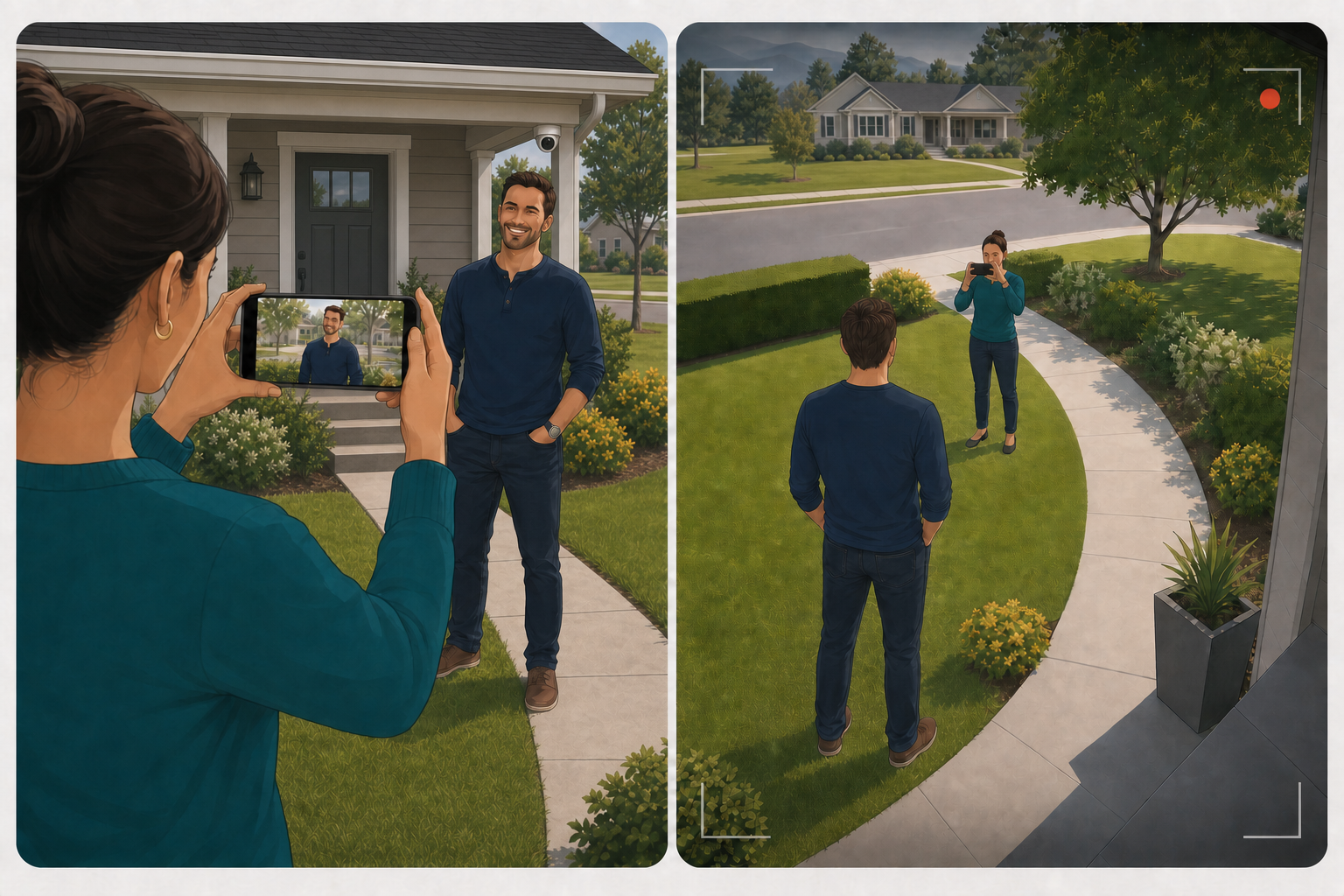 The phone gets a clear face because someone chose the subject and angle. The fixed security camera records the same moment from wherever it was installed.
Why Not Make Every Security Camera Phone Quality?
Some security cameras can capture excellent footage, but phone-quality video everywhere is harder than it sounds.
A phone records short clips when a person asks it to. A security camera may record every motion event, stream live view, save local clips, upload cloud clips, run night vision, detect people or vehicles, and stay ready all day. Multiply that by several cameras and the cost becomes hardware, storage, bandwidth, battery, heat, and subscription infrastructure.
That is why many cameras balance quality with practical constraints. They need to be affordable enough to place around a home, efficient enough to run reliably, and compressed enough that the clips can be stored and opened in an app.
The result is a camera that is good at noticing activity, but not always good at producing a clean, zoomable, forensic-looking clip from every corner of the frame.
How security cameras store footage
Can security cameras record without Wi-Fi?
Why Strange-Object and UFO-Style Clips Look So Bad
Strange-object clips are often hard to judge because security cameras are easy to fool visually. A small thing can look large. A close thing can look far away. A reflection can look like a light in the sky. A bug near the lens can look like it is moving impossibly fast.
When people say a security camera captured a UFO, they usually mean it captured an unidentified object. That part can be true. The object may be unidentified in that clip. But unidentified does not automatically mean extraordinary.
- Small things can look dramatic
A bug, spider web, dust particle, raindrop, or leaf close to the lens can look much bigger than it is.
- Far things have very few pixels
Aircraft, drones, satellites, meteors, birds, and distant lights may occupy only a tiny part of the frame.
- Lights confuse the camera
Headlights, porch lights, streetlights, reflections, lens flare, infrared light, and bright sky can all distort how a clip looks.
- Distance is hard to read
A single fixed camera does not always tell you whether a light is near the lens, across the street, reflected in glass, or high in the sky.
- Tracking may ignore it on purpose
Many cameras are tuned to care about people, vehicles, packages, or meaningful motion. A tiny light or bug may not trigger tracking because the system is trying to avoid false alerts.
- Short clips remove context
The full before-and-after footage may show the object's path, source, reflection, weather, or ordinary explanation.
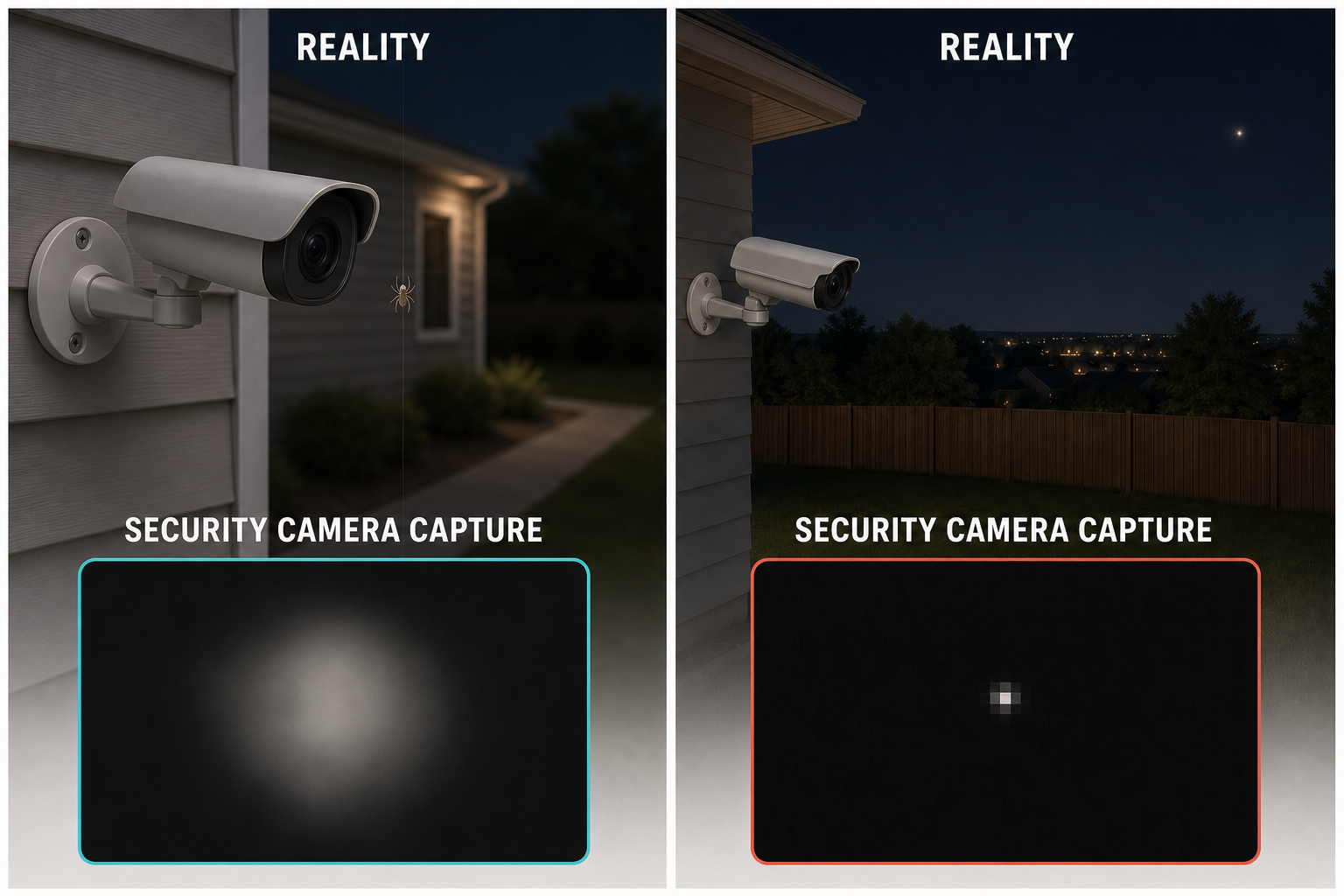
A tiny object near the lens can become a large mystery blob, while a distant light may be reduced to only a few pixels.
Why Suspect Footage on the News Can Still Look Bad
Suspect footage is more frustrating because this is closer to what people expect security cameras to do. If a camera is for security, why can it show the crime but not clearly show the person?
The answer is that many security cameras are placed to detect and document activity, not guarantee identification-quality close-ups. A camera watching the whole driveway may show that someone approached a car, but the face may be small, angled away, shadowed, covered by a hood, or blurred by motion.
This is the difference between capturing the event and capturing enough identifying detail. They are related, but they are not synonymous.
| Why the event is visible | Why identification may fail |
|---|---|
|
|
Coverage and Identification Are Different Goals
A camera that covers the whole yard is useful because it gives context. But the more area one camera covers, the fewer pixels are available for any one person, vehicle, or object.
That is why a single wide-angle camera can be good at proving that something happened and bad at proving exactly who did it. For identification, the camera usually needs to be closer to the route a person must take: the porch, gate, walkway, garage door, driveway entrance, or side path.
This is also why some systems use multiple cameras or dual-lens security cameras. One view gives context. Another view gets closer detail.
Compression Makes Both Kinds of Footage Worse
Compression might be the most boring but important reason security clips look bad. Video files are large, and security systems need to store or upload many clips without overwhelming storage, bandwidth, or app playback.
Compression can smear motion, simplify shapes, flatten faces, create blocky edges, and make dark areas look muddy. A clip may look even worse after it is downloaded, screen-recorded, cropped, shared in a message, shown on TV, or reuploaded to social media.
That matters for UFO-style clips and suspect clips. In both cases, the detail people want is usually small. Small details are exactly what compression tends to damage first.
Are solar security cameras worth it?
Night Footage Raises the Difficulty
Night footage is where many security cameras look worst. Less light means more noise, more motion blur, less color, and more reliance on infrared or spotlights.
For strange-object clips, night vision can make bugs, webs, rain, dust, and reflections look more mysterious. For suspect clips, low light can hide the details people care about most: face, clothing, hair, shoes, license plates, and direction of travel.
Better lighting and the right night vision mode can help, but they still have to be matched to the location. A bright spotlight aimed poorly can wash out a face just as easily as darkness can hide it.
Choosing the right security camera night vision
How to Evaluate a Bad Security Camera Clip
The right questions depend on the type of clip. A strange light and a suspect walking through a driveway need different kinds of context.
| For strange-object clips | For suspect or news clips |
|---|---|
|
|
What Would Make the Footage Stronger Evidence?
A clip becomes stronger when it has context. The most useful evidence is not just sharper video; it is a clearer chain of information.
For a strange object, stronger evidence means the original file, full duration, camera direction, weather, nearby lights, and another angle. For a suspect clip, stronger evidence means a closer view, a better angle, face-level lighting, and footage from the route the person had to take.
In both cases, unclear footage is a starting point. It tells you something appeared or happened. It does not always tell you enough to make the final call.
Bottom Line
Security camera footage often looks worse than phone footage because security cameras are fixed, wide, unattended, compressed, and storage-conscious. Phones are close, aimed, actively controlled, and built around short high-quality clips.
For strange-object clips, the problem is often scale, reflections, near-lens objects, night vision, and missing context. For suspect clips, the problem is often distance, angle, lighting, compression, and the difference between capturing an event and identifying a person.
That does not make security cameras useless. It means blurry footage should be treated carefully: useful as a clue, but not always enough as proof.
FAQs
Why is security camera footage so bad compared with phone video?
Phone video often looks better because a person is close to the action, aiming at the subject, using autofocus, and recording a short clip. A security camera is fixed, wide-angle, unattended, compressed, and often recording from far away.
Why is UFO footage from security cameras usually blurry?
Security cameras are not built to identify distant or tiny sky objects. A light or object may be far away, close to the lens, reflected, compressed, or affected by night vision. The clip may show an unidentified object without proving what it was.
Why are suspect clips on the news often unclear?
Many cameras are positioned to capture activity across a wide area, not face-level identification detail. Distance, camera angle, motion blur, low light, hats, hoods, backlighting, and compression can all make a suspect hard to identify.
Does blurry security footage mean the video is fake?
No. Blurry footage can be real but incomplete. It may show that something happened without proving exactly what the object was or who the person was.
What makes security camera footage stronger evidence?
Original files, full before-and-after footage, known camera location and direction, good lighting, closer camera placement, and additional angles from other cameras all make footage stronger.